

Encoders: How Can You Make a Robot More Precise Without Weighing It Down?
Less space, higher expectations: the challenge of today’s robot joints
Robot designers have to reconcile two conflicting demands: joints that keep getting shorter, lighter and cheaper, and motion that must be increasingly precise, smooth and safe. Collaborative, humanoid and surgical robots push both demands to the limit. Inside every joint sits an encoder, the sensor that tells the robot the exact position of its arm and on which the precision of its movements depends. But how do you fit a precise encoder, immune to motor interference, into an ever smaller joint without adding weight, parts or complexity?
This article looks at the problems engineers face, how Netzer Precision encoders solve them, and how EMG2, Netzer’s partner, supports you all the way from choosing the encoder to putting your robot into production.
Five constraints in every robot joint
Whether they design industrial arms, cobots, mobile manipulators or medical robots, engineers run into the same difficulties at joint level:
- Every millimetre and every gram counts: joints must be as short and light as possible, because every extra gram in a distal joint has to be carried, accelerated and braked by every joint upstream of it.
- Two encoders, twice the integration work: adding a load-side encoder improves accuracy, but it also adds parts, cabling and assembly steps to an already crowded joint.
- A noisy environment: motor magnets, brakes and power electronics sit just a few centimetres from the sensor. Magnetic and electrical interference can degrade the signal, which is unacceptable in surgical or collaborative robots, where precision and safety go hand in hand.
- Tight mechanical tolerances: many encoders require precise alignment, which slows down assembly and makes production yields sensitive to the slightest mechanical variation.
- Fast, smooth motion: insufficient feedback bandwidth or resolution shows up as vibration, overshoot and jerky movements when the robot reacts to its environment.
Netzer’s answer: a contactless, interference-free encoder

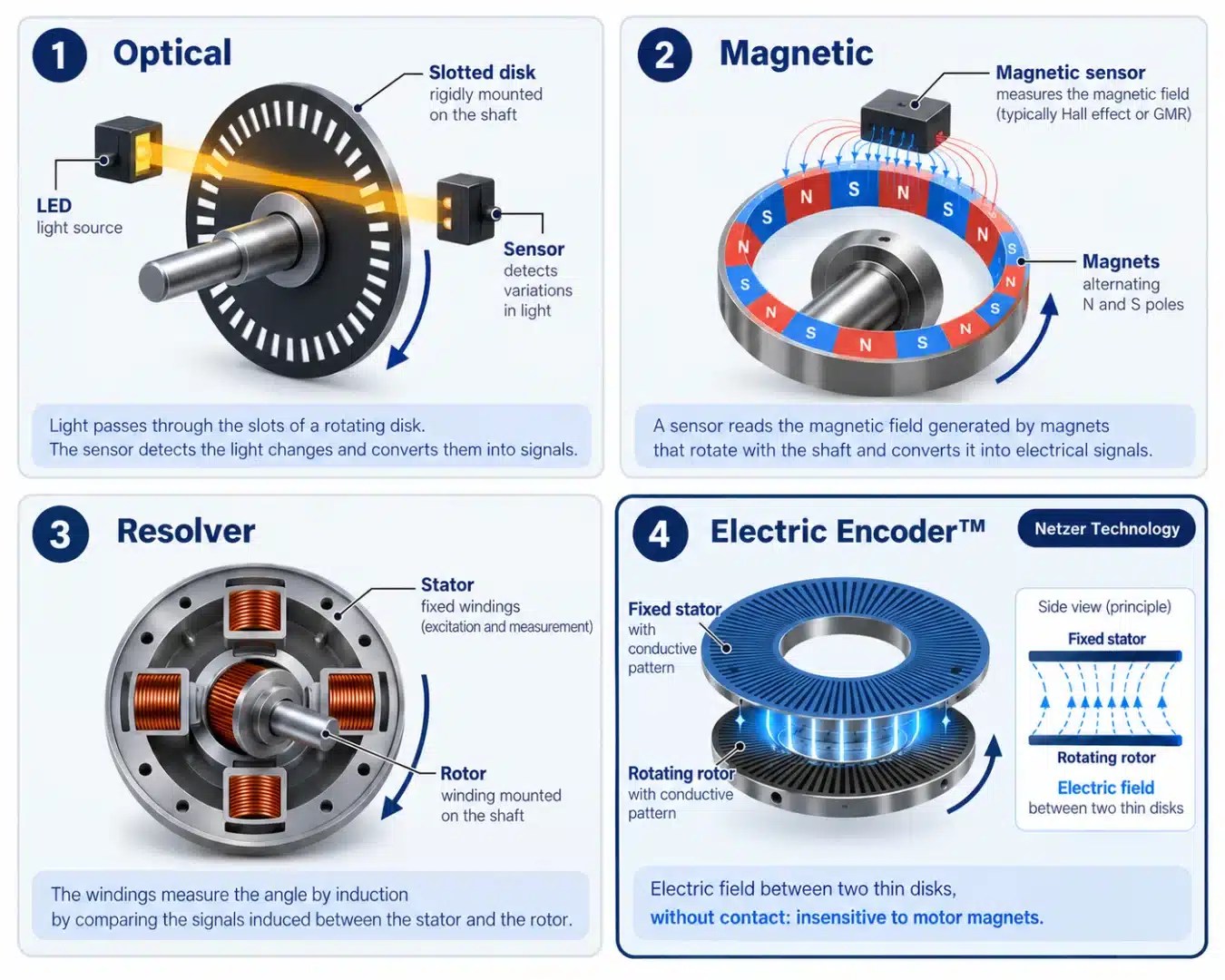
Netzer Precision designs absolute rotary encoders based on its contactless capacitive technology, the Electric Encoder™. Most encoders measure rotation using magnets or an optical disc. Netzer’s relies on a different principle: the Electric Encoder™ measures the angle using the electric field between two thin discs, one fixed and the other rotating with the joint, without ever touching. The result: no wear over time, and no interference from the motor magnets.
The Electric Encoder™ versus other technologies
In robotics, there are three other main families of encoders: optical (light passes through a graduated disc), magnetic (a sensor reads the field of a rotating magnet) and resolvers (windings measure the angle by induction). Each has its strengths, but each runs into different limits once integrated into a compact joint, right next to the motor.
| Criterion | Optical | Magnetic | Resolver | Electric Encoder™ |
|---|---|---|---|---|
| Size and weight | Medium to high | Low | High | ✔ Very low |
| Sensitivity to motor magnets | Low | High | Low to moderate | ✔ None |
| Dust, oil, condensation | Sensitive | Robust | Very robust | ✔ Robust |
| Mounting tolerance | Low | Medium | High | ✔ High |
| Resolution | Very high | Medium | Medium | ✔ High (17 to 23 bits) |
The Electric Encoder™ thus combines the slimness of a magnetic sensor, a resolution close to optical, and complete immunity to motor magnets: exactly what a compact joint requires.
High bandwidth and high resolution for smooth motion
Netzer encoders deliver continuous, full-circle absolute position feedback with high accuracy and bandwidth. The robot can therefore respond quickly and smoothly to changes along the arm. Resolution ranges from 17 to 23 bits depending on the model.
Thin, light and hollow-shaft
The VLX Robotics & Industry range is designed for compact joints. It runs from the VLX-25 (25 mm outer diameter, 3.6 g) to the VLX-247 (247.7 mm, 10 mm high), with a hollow shaft for cable routing and a low-inertia rotor.
Fewer parts, a more compact robot
Because the measurement is capacitive rather than magnetic, the encoder can be placed close to the motor magnets and mounted on the load side without being disturbed. The joint therefore needs fewer parts, which reduces its size, complexity and overall cost.
Tolerant mounting
The Electric Encoder™ accepts wider mechanical installation tolerances than many alternatives, making assembly easier in complex mechanisms.
Built for harsh environments
Netzer’s technology was first developed for aerospace and space missions. Its EMI/EMC robustness is a real advantage in highly integrated systems, particularly in surgical robotics, where signal stability and immunity to electrical noise are essential.
For more demanding environments, the range also includes the VLP (harsh environments), VLT (–55 °C to +125 °C), DS (encapsulated) and VLM (multi-turn) families.
The missing piece: a local partner who knows your robots’ components
The best encoder still has to be chosen, tested, integrated and delivered on time. For nearly 30 years, EMG2 has been supplying innovative technology building blocks and electronic solutions: components, modules, boards and platforms ready to be configured for rapid deployment. Based in Villebon-sur-Yvette (Courtabœuf), near Paris, we work with recognised international manufacturers and act as our customers’ single technical and commercial contact.
Netzer Precision is one of those partners. As a high value-added distributor, we help you choose the right model for each joint of your robot, get samples and evaluation hardware quickly, and support you from prototype through to volume production of your robot.
Local technical support, from selection to production
Our role: turning a catalogue into a working robot. In practice, EMG2 supports you at every stage:
- Selection: we review the diameter, height, hollow-shaft diameter, accuracy target and environment of your robot’s joint, then recommend the right Netzer range and model.
- Evaluation: we can help you set up samples and Netzer’s EVL evaluation encoder to validate performance on your own test bench.
- Integration: our technical team answers your mounting, calibration and interface questions, in English or French, and calls on Netzer’s engineers when needed.
- Production and follow-up: following receipt of your order, we handle the supply of encoders and remain available to answer your field questions quickly.
Beyond product support, EMG2 also offers system integration and custom development services, including vision and AI, which are useful when the encoder is just one part of your larger robotic system.
One partner for the entire motion chain
A robot joint is more than its position feedback. Because EMG2 covers the entire motion and electronics chain, you can source compatible building blocks from a single partner and reduce the number of interfaces to manage.
| Areas | EMG2 offerings for robotics |
|---|---|
| Motors | Stepper and hybrid motors, BLDC, frameless torque motors, DC micro-motors, linear actuators, gearboxes, custom designs |
| Drives and servo control | Miniature motor control up to 700 mW, controller boards up to 20 A, 70 A and 135 A modules, custom controllers |
| Other position sensors | Absolute linear encoders, including cable-free read heads and capacitive linear micro-encoders |
| Power | Power distribution units (PDU), solid-state smart circuit breakers, rugged DC-DC and AC-DC power conversion, LFP batteries |
| Vision and Edge AI | 3D and ToF cameras, camera modules, Edge AI platforms |
| Embedded systems | SBCs, box PCs, data storage, Ethernet switches |
Explore our full range on our Motion Control & Energy and Robotics & Drones pages.
Which encoder for your application?
Tell us about your robot: joint dimensions, accuracy target, environment and production volumes. Our team will recommend the right Netzer encoder and the components around it.
Or call us: +33 (0)1 69 59 14 31